
Blog
Should Your Club Build Its Own Data Hub? A SWOT for the People Who’d Have to Do It

Every performance department has had the conversation. The GPS lives in one portal, the wellness scores in a Google Form, the match data in a spreadsheet someone built in 2019, and the medical notes in a system nobody outside the physio room can open. Someone says: we should just build our own hub. Pull it all together. One place, our way.
It’s a reasonable instinct. Plenty of clubs have followed it, and some have done it well. But it’s a decision that tends to be made on enthusiasm and paid for in evenings, so it’s worth putting through a proper SWOT before the first line of code or the first Power BI licence.
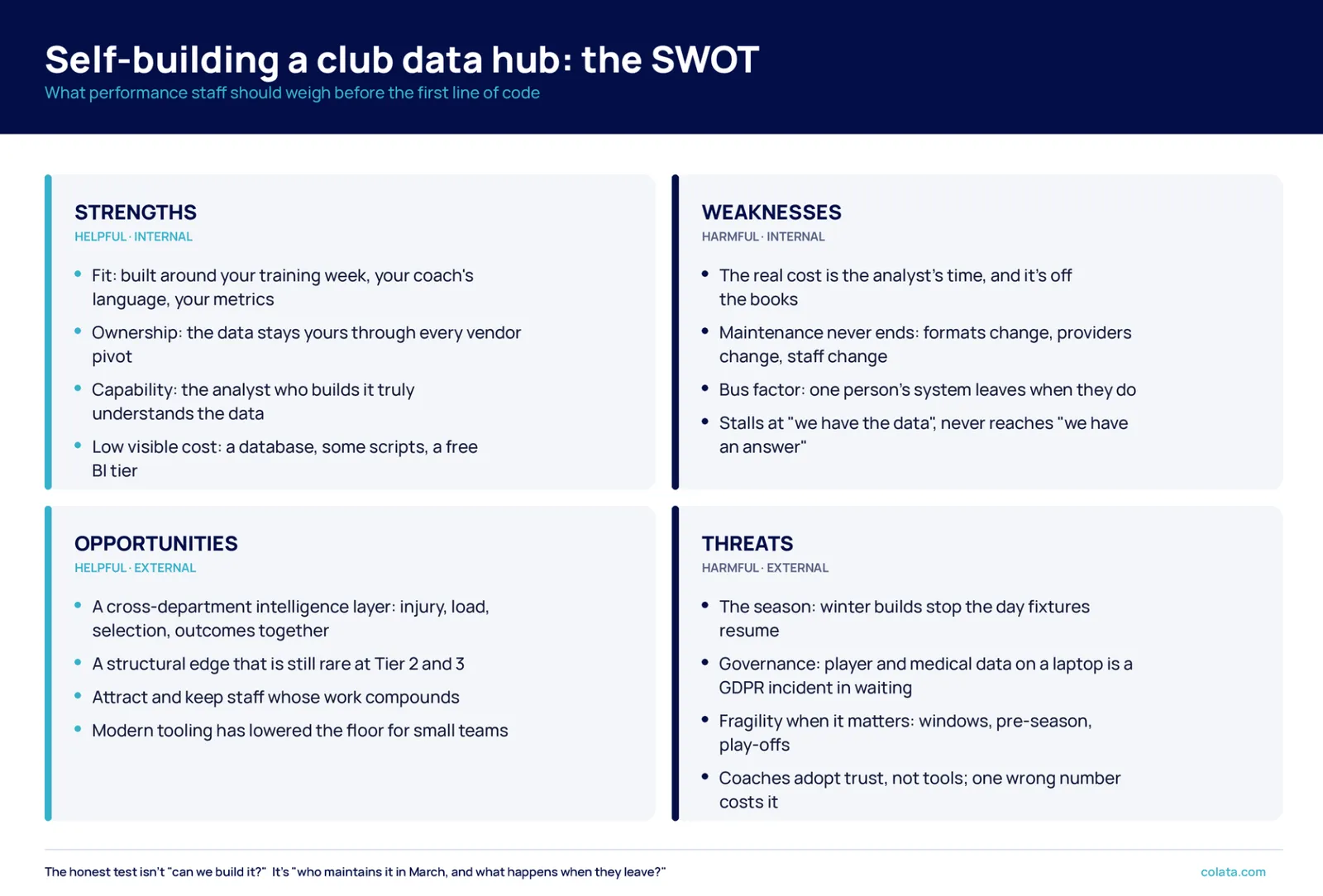
Strengths: what a self-built system gets right
The strongest argument for building it yourself is fit. Nobody understands your club’s questions better than the people asking them. A hub designed in-house is shaped around your training week, your coach’s language, the metrics your medical team actually trusts, and the reports your manager reads rather than the ones a vendor thinks he should read. There’s no translating your world into somebody else’s data model.
Ownership follows from that. The data sits where you put it, structured how you chose, and no subscription lapse or vendor pivot can take it away. If you’ve ever lost three seasons of load data because a provider was acquired and “sunset” their platform, this is not a small thing.
There’s also a real capability dividend. The analyst who builds a pipeline understands the data in a way that no dashboard user ever will. They know where the GPS drops out, why Tuesday’s RPE always looks odd, and which columns in the export are quietly unreliable. That understanding makes for better questions and more honest answers, and it stays with the club.
And on paper, the cost is low. A Postgres database, a couple of Python scripts, a free BI tier. For a Tier 2 or 3 budget, “we already pay that analyst” is a persuasive line.
Weaknesses: what the budget line doesn’t show
The cost is low on paper because the biggest cost is off the books. It’s the analyst’s time, and analysts at this level are rarely just analysts. They’re also the video person, the GPS person, the person who drives the van. Every hour spent maintaining an ingestion script is an hour not spent on the thing they were hired for, which is helping coaches make better decisions.
That maintenance never ends. Vendors change their export formats. The club switches wearable provider. A new sports scientist arrives with different naming conventions. A hub that took a winter to build takes every subsequent winter to keep alive, and the work is invisible right up until it breaks on a Friday before a match.
The deeper weakness is the bus factor. Most self-built systems are one person’s system. When that person leaves for a Premier League academy or a county job with a better pension, what remains is a folder of scripts, a database with no documentation, and a head of performance who now has to explain to the manager why the dashboards stopped updating. Continuity is the thing under-resourced clubs can least afford to lose, and it’s precisely what a one-person build puts at risk.
Finally, there’s the gap between a database and intelligence. Storing the data is the easy part. Turning it into something a coach will act on at 7am on a Wednesday, in a form that survives contact with a sceptical assistant manager, is design work. Most self-builds stall at the “we have all the data” stage and never reach “we have an answer.”
Opportunities: what building could unlock
None of the above means don’t build. It means be clear what you’re building for.
The best opportunity is a genuine club intelligence layer: a place where injury history, load, selection, and match outcomes sit together so that the club can ask questions across departments rather than within them. Did our late-season injury spike follow the fixture congestion or the change in pitch? Which players are we consistently under-rating at recruitment? Clubs that answer those questions have a structural edge over rivals who can’t, and at Tier 2 and 3 that edge is still rare enough to matter.
There’s a recruitment and retention story too. A club that treats data as infrastructure rather than a hobby attracts better staff and keeps them longer. Analysts want to work somewhere their work compounds.
And modern tooling has lowered the floor. Cloud databases, open-source pipelines and AI-assisted analysis mean a small team can now build something that would have needed a data engineering hire five years ago. The question is no longer can it be done, but whether the club can sustain it.
Threats: what will quietly kill it
The first threat is the season. Building a data system is winter work, and clubs don’t have a winter. The moment fixtures resume, the hub drops to the bottom of the list and stays there. Half-built systems are worse than none, because they consume trust as well as time.
The second is governance. Player data is personal data. Medical data is special category data. A hub built in a hurry on someone’s laptop, with shared logins and no audit trail, is a GDPR incident waiting for a disgruntled ex-employee or a lost bag. The clubs most likely to self-build are the ones least likely to have a data protection officer looking over the build.
The third is fragility at the exact moment it matters. Systems get tested in transfer windows, pre-season, and the week before a play-off. That’s when the data volume spikes, the questions get urgent, and the one person who understands the pipeline is busiest. A hub that works nine months of the year and fails in the three that count has failed.
And the last threat is the most human. Coaches don’t adopt tools; they adopt trust. A self-built system with a rough interface and occasional wrong numbers loses credibility fast, and once a manager has decided the dashboard is “the analyst’s thing,” it doesn’t matter how good the model underneath it is.
So what should a club actually do?
The SWOT points to a distinction that gets lost in the build-or-buy framing. There are two different jobs here. One is the plumbing: getting data in, keeping it clean, keeping it secure, keeping it running when the person who built it is on holiday. The other is the intelligence: asking your club’s questions, in your club’s language, and getting answers a coach will act on.
Clubs are right to want to own the second. Very few are equipped to own the first, and it’s the first that quietly eats the analyst, the winter, and the credibility. The clubs getting this right are the ones that stopped treating the plumbing as a badge of honour and started spending their scarce expert hours where the belief lives: on the questions, and on backing them with evidence.
If you’re weighing this up at your club, the honest test isn’t “can we build it?” It’s “who maintains it in March, and what happens when they leave?”